
Video Analytics or Sensors? Finding the best People Counting Tech for your Business
Do you want to improve your business by adopting a people counting solution but feel overwhelmed by the options? With video analytics and sensor-based technologies offering different advantages, choosing the right system can be challenging.
Published
May 26, 2026
.avif)
Key Facts
- The technologies for people counting range from infrared or thermal sensors to specialized 3D or LiDAR sensors, Wi-Fi and Bluetooth technology, and video analytics.
- When choosing the right technology, criteria such as accuracy, scalability, maintenance requirements, and the expected data output and insights should be taken into account.
- These technologies vary significantly in terms of cost-efficiency, accuracy, data privacy, and the scope of their use cases.
- In a direct comparison, video analytics performs best. However, the specific, individual use case should always be carefully considered before making a final decision.
Why is people counting relevant?
Understanding foot traffic is crucial for business growth in retail, shopping centers, airports, public transport hubs and any operation with high footfall. Accurate people counting enables businesses to optimize operations, enhance customer experiences, and improve safety. While sensor-based systems have replaced manual counting methods, the rise of artificial intelligence has further advanced people counting with video-based solutions, offering greater accuracy and deeper insights.
With a wide range of systems and providers available, choosing the right people counting solution can be challenging.
Keep reading to discover the strengths and limitations of different technologies for people counting to help you determine the best fit for your business needs.
Which technologies are there for people counting?
Sensors
Hardware-dependant technologies for people counting include infrared and thermal sensors imaging to detect and count people as they pass through a designated area. These systems are widely used in entryways, corridors, and public spaces where privacy is a concern. These sensors are cost-effective and easy to install, but fail completely in crowds, cannot determine directional flow easily, and give zero contextual data. Good for absolute privacy as there are no images captured, and small spaces like restrooms or office meeting rooms. However, especially thermal sensors are expensive to scale, require dedicated hardware, and struggle in environments with fluctuating ambient temperatures.
A standard in retail business for sensor-based people counting are specialised 3D Time-of-flights sensors or LiDAR sytems. The sensors emit light pulses to measure distance, creating a highly accurate 3D depth map of moving objects. It offers high accuracy and inherently privacy-compliant because they don't capture RGB video. However, the hardware is expensive and requires complex, specialized installation. It's difficult to scale across a whole smart city or a massive airport terminal.
Wifi or Bluethooth
People counting with wifi or Bluetooth pings the unique MAC addresses of nearby smartphones to estimate footfall, dwell time, and journeys. This works great for tracking wide-area customer journeys but is inaccurate for counting actual heads. Many modern smartphones randomize MAC addresses for privacy; people carry multiple devices or none, and you can't distinguish between a human passenger and a device left in a parked car.
This technology is most commonly deployed in expansive areas such as large shopping malls, airports, theme parks, or public city festivals to anonymously analyze visitor flows, pathways, and average dwell times within specific zones.
Video Analytics
AI-powered people counting leverages computer vision and machine learning to analyze video footage from security cameras. The system detects, tracks, and counts individuals in real time, providing more than just foot traffic trends like dwell time, visitor demographics, customer journey mapping, and queue management insights. As the existing camera infrastructure is used, video analytics comes with a low investment hurdle. Addressing privacy concerns: Many video analytics software, like Isarsoft Perception is privacy-compliant by design. Automatic anonymization of faces and personal information occurs in the second the video footage is created.
The areas of application are diverse and theoretically viable anywhere security cameras are in use. This ranges from small retail shops and airport terminals to deployments inside vehicles and traffic monitoring for entire cities.
Dimensions to consider while choosing a people counting solution
Accuracy
Accuracy in people counting systems refers to how precisely they track individuals, and this can vary depending on the technology used. To make an informed decision, it’s important to understand how AI-based, specialized 3D, and basic sensor systems function.
- Infrared or Thermal Systems:
These traditional systems typically rely on simple beam-break or heat detection to register movement. While they can provide reliable entry and exit data in small, controlled spaces, they struggle in crowded settings where individuals walk closely together or move unpredictably. Because they lack visual or spatial depth context, a tight group of people is often registered as a single body, leading to undercounting in high-foot-traffic environments.
- LiDAR & specialized 3D Sensors:
These technologies emit physical light or laser pulses to construct a highly detailed 3D depth map of the environment. Because they measure exact spatial distances, they offer exceptional accuracy and excel at pinpointing individual physical coordinates, even in complete darkness. However, achieving this accuracy requires strict, meticulous physical calibration. If the sensor's narrow field of view is slightly misaligned or obstructed by architectural elements, its spatial precision drops significantly.
- AI Video Analytics:
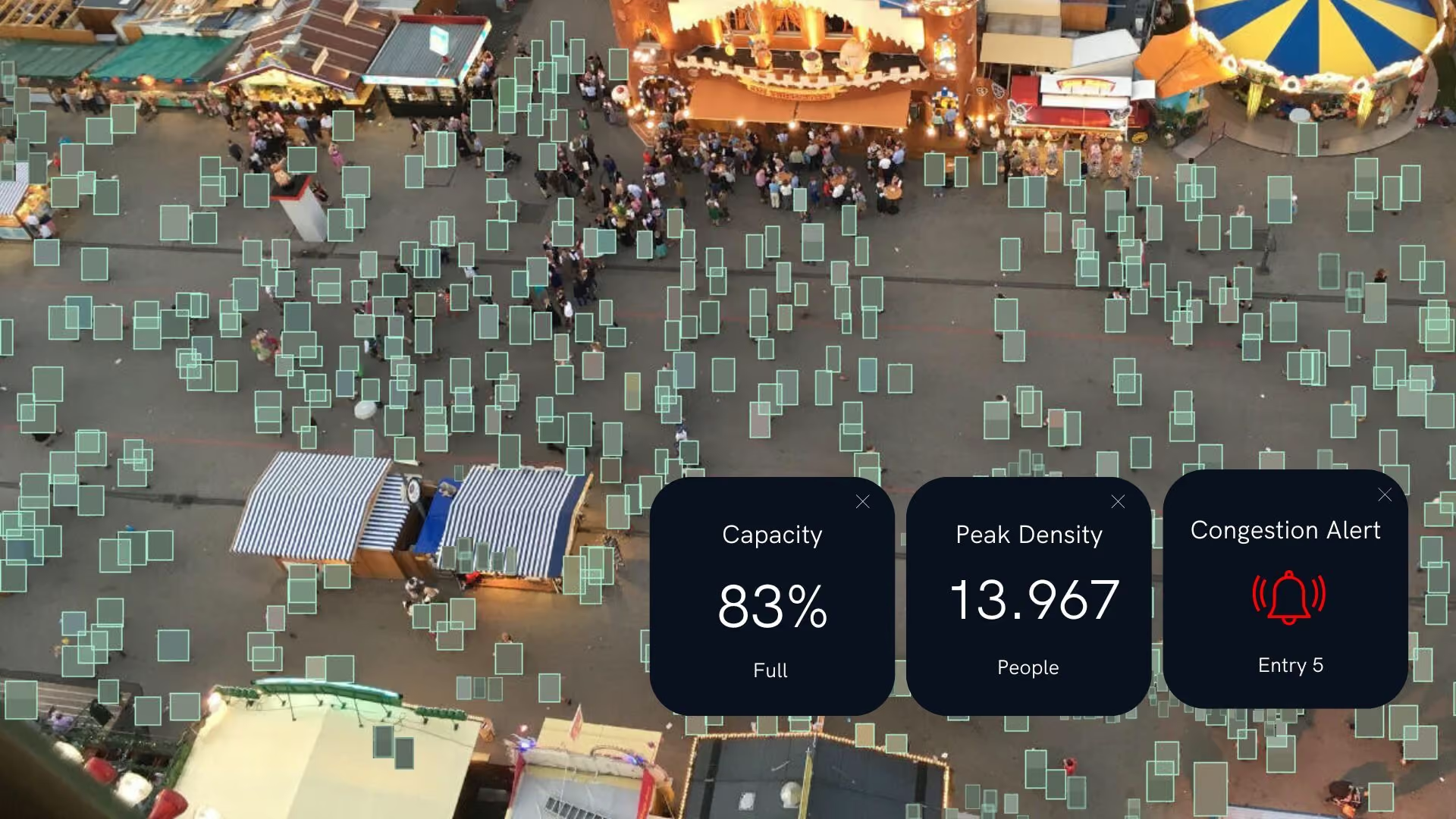
These systems leverage advanced image recognition to distinguish between people and objects, reducing errors caused by factors like shadows, reflections, or overlapping individuals. This makes them highly effective in dynamic environments such as retail stores, transportation hubs, and museums, where foot traffic is unpredictable and dense. Furthermore, advanced video analytics handles occlusion by continuously tracking paths and using "late count" algorithms to maintain maximum accuracy in heavy crowds.
Crowd counting insights
Scalability
Scalability refers to how easily a technology can expand alongside an enterprise and adapt to different environments. Securing a long-lasting solution that improves over time is essential for operators that anticipate growth, manage multiple facilities, or need to adjust dynamically to fluctuating visitor numbers.
- Infrared or Thermal Systems:
These systems rely entirely on dedicated hardware at every single entry and exit point. Scaling up requires purchasing, wiring, and physically mounting new physical sensors into door frames or ceilings. Because these sensors operate as isolated data silos, managing an expanding network of hundreds of separate units across multiple locations creates significant backend complexity and high hardware overheads, offering very low long-term structural flexibility.
- LiDAR & Specialized 3D Sensors:
While highly accurate in their localized deployment zones, scaling 3D laser infrastructure presents a massive bottleneck. Every new entryway, platform, or corridor requires the purchase of expensive, specialized hardware units. Because LiDAR demands meticulous spatial calibration, expanding the system requires specialized engineers on-site for installation and alignment. For massive airport terminals, entire transit networks, or multi-location retail chains, the compounding CAPEX and installation complexity make widespread scaling highly restrictive.
- AI Video Analytics:
AI-powered people counting offers unmatched scalability because it shifts the burden from hardware to software. By integrating directly with existing security camera networks via IP, expanding your coverage requires nothing more than a software activation on additional cameras. This makes the entire expansion process seamless, rapid, and highly cost-effective without triggering extensive hardware procurement cycles. Furthermore, because these solutions leverage machine learning, the algorithms continuously adapt and refine their precision over time, unlocking deeper operational insights as more data is processed.
Maintenance
Ongoing maintenance is a key consideration when selecting a people counting system. While this largely depends on the provider and the level of customer support, the general maintenance requirements differ significantly across AI-based, 3D laser, and traditional sensor solutions. Selecting a system with minimal upkeep reduces operational disruptions and ensures continued reliability, making it a crucial factor for long-term efficiency.
- Infrared or Thermal Systems:
Traditional hardware sensors require regular manual intervention. Physical components like infrared lenses or thermal grids are highly susceptible to wear, accumulation of dirt, and hardware degradation over time. Maintaining accuracy requires frequent on-site cleanings and manual recalibrations. Over the lifecycle of the system, the necessity for physical hardware replacements can lead to higher long-term maintenance costs and increased operational downtime compared to software-driven alternatives.
- LiDAR & Specialized 3D Sensors:
Although these premium sensors contain fewer moving parts than legacy hardware, they require periodic physical cleaning and precise recalibration. Because they rely on active light pulses, environmental factors like heavy dust, lens smudges, or minor physical shifts in the building structure can distort the 3D depth map. Correcting these alignment issues requires specialized on-site technical support, which can increase long-term maintenance costs and cause planned operational downtime.
- AI Video Analytics:
AI-based systems typically receive software updates, security patches, and algorithm enhancements remotely, eliminating the need for physical adjustments or on-site servicing. Since the logic is entirely software-defined, the system’s capabilities can be expanded or recalibrated from a central dashboard. This makes long-term upkeep exceptionally convenient, predictable, and virtually non-disruptive to daily business or transit operations.
Data & Insights
The level of insight provided by people counting technology varies fundamentally depending on the architecture used. For enterprises looking to close the predictability gap, bridge staff shortages, and enhance customer or passenger experiences, having access to detailed analytics is key to making informed, data-driven decisions.
- Infrared or Thermal Systems:
While effective for tracking baseline entry and exit numbers, traditional sensors are highly limited in scope. They primarily provide raw footfall numbers without any additional context or behavioral metadata. This makes them suitable only for basic visitor count tracking at a single doorway rather than in-depth behavioral recognition or flow optimization.
- LiDAR & Specialized 3D Sensors:
3D lasers are highly effective at tracking precise spatial positioning and movement lines within their exact field of view. This makes them valuable for localized queue management or monitoring specific zone occupancy thresholds. However, they lack the visual capabilities to classify objects beyond their physical dimensions. They cannot differentiate between diverse target groups, or detect specific object categories, limiting their application strictly to physical spatial tracking.
- AI Video Analytics:
AI systems offer far more than just basic counting, they deliver comprehensive spatial intelligence. By extracting non-biometric metadata from video streams, they provide advanced analytics such as heatmaps, queue monitoring, dwell times, and multi-modal traffic tracking, such as distinguishing between a passenger, a wheelchair, or a piece of luggage. These insights help operational leaders optimize layouts, match staffing to actual customer frequency, and refine store layout planning. The resulting data is typically accessible through interactive dashboards or seamlessly fed into existing VMS and business intelligence tools via APIs for real-time decision-making. To see which insights Isarsoft Perception delivers for your business, explore our people counting page.
Technologies in direct comparison
While both AI-based and sensor-based people counting technologies serve the same fundamental purpose, they differ in how they capture and process data. To determine which solution is best suited for a given environment, it’s important to compare their key characteristics.
More than counting
To optimize planning, operations, and safety, modern enterprises require deeper insights than isolated hardware sensors can provide with people counting. Traditional hardware approaches force operators into a continuous cycle of high investment hurdles and infrastructure silos. Every expansion requires new physical units, complex installations, and independent data maintenance.
By shifting the paradigm from rigid hardware to a software-defined ecosystem, Isarsoft Perception transforms existing security cameras into an intelligent network. This eliminates the need for expensive new hardware investments while delivering exceptional data accuracy. Future people counting technology will be expected to connect smoothly with other operational systems. The most valuable solutions will not just report occupancy data, but feed it into automation workflows, dashboards, and control systems. Isarsoft already picks this up today with several opportunities to integrate VMS and business intelligence systems. Performance will be held upright steadily in the future with ongoing model refinement.
Deploying analytics across public transport networks, airports, or retail environments requires strict compliance. Instead of capturing biometric details or relying on high-risk device-tracking methods like MAC addresses, the system relies strictly on non-biometric metadata.
Because the processing occurs dynamically in the system memory without saving personal information, operations remain entirely GDPR-compliant. Backed by an official ISO 27001 certification from TÜV Süd, Isarsoft Perception guarantees data protection and information security at every level of operation.
FAQ
Can't find the answer to your question?
Contact us now!
What people counting technologies are available besides video analytics?
Common alternatives include infrared and thermal sensors, specialized 3D/LiDAR sensors, and Wi-Fi or Bluetooth-based tracking that pings nearby smartphones. Each has different trade-offs in accuracy, cost, and privacy.
Why do infrared and thermal sensors struggle in crowded environments?
These sensors typically rely on simple beam-breaks or heat detection, so a tight group of people is often registered as a single body, leading to undercounting in busy, high-traffic environments.
How does video analytics compare to LiDAR or 3D sensors for people counting?
LiDAR offers very high spatial accuracy but requires expensive, specialized hardware and meticulous calibration at every location, limiting scalability. Video analytics reaches comparable accuracy using existing IP cameras, making it far easier and cheaper to scale across many sites.
Is Wi-Fi or Bluetooth tracking a reliable way to count people?
Not for precise headcounts. It pings device MAC addresses rather than people directly, so results are skewed by MAC address randomization, people carrying multiple devices, or none at all. It's better suited to estimating wide-area journeys than exact counts.
What data privacy advantages does video analytics offer over device-tracking methods?
Unlike Wi-Fi or Bluetooth tracking, which relies on unique device identifiers, video analytics such as Isarsoft Perception uses non-biometric metadata with automatic anonymization and pixelation, avoiding the privacy risks tied to tracking specific devices or people.
Explore More Publications

6 Reasons for Isarsoft Video Analytics
Isarsoft Perception turns existing security cameras into smart sensors that count people, track customer journeys and detect vehicles, with privacy built in. Here are six reasons why transit operators, airports, retailers and museums choose Isarsoft video analytics.
.png)
Artwork Protection at Kunstmuseum Stuttgart with Isarsoft
To protect priceless artworks without resorting to ropes, glass cases, or rigid sensor grids, Kunstmuseum Stuttgart implemented Isarsoft Perception's AI-powered video analytics software. By converting its existing security camera infrastructure into invisible, precision-tuned protection zones, the museum is able to automate artwork protection in real time.

Monitoring Occupancy and Seat Availability in Public Transportation
Passenger counts tell operators how many people are on board, not where the remaining capacity is or what kind it is. We look at how seat-level and multifunctional-area occupancy monitoring gives transport operators that missing data.
.avif)
What is Re-ID? Multi-Camera-Tracking in People Counting
Person Re-Identification, or Re-ID for short, is a computer vision technology that uniquely identifies individuals across different, non-overlapping camera fields of view. While traditional people counting often reaches its limits when individuals leave one camera's field of vision and reappear in another, Re-ID solves the problem of double counting.

Top 5 Challenges Associated with People Counting
Explore the top five challenges in people counting systems, from accuracy and integration to privacy concerns - and how to solve them.
.avif)
How to: Customer Journey Analysis with Re-ID in Retail
Customer journey analysis with Re-ID provides the retail industry with precise data on footfall, customer behavior, and space utilization. Based on these insights, retailers can make smart decisions for both marketing and operations.