
Optimizing the EES bottleneck: Why Airports choose Video Analytics for Queue Management
With the real-world EES processing times taking up to 5 minutes per passenger, legacy airport queue models have officially collapsed. Discover how airports are using AI-powered video analytics to transform their existing cameras into predictive tools that eliminate terminal bottlenecks before they form.
Published
June 2, 2026
.avif)
Key Facts
- The new Entry/Exit System (EES) forces airports to establish an adjusted border control process with capturing and documenting biometric data at self-service kiosk.
- EES implementation is massively effecting passenger flow, because space in terminals is limited, and queues at border control quickly backs up.
- Traditional queue management can not longer be applied on EES processes as process times vary between passenger groups, e. g. a EU citiziens only needs a few seconds, a EES-first-registered passenger needs up to a few minutes.
- Airports need to switch to smarter terminal management with dynamic passenger routing and queue management based on real-time data.
- Video Analytics analyzes video streams from the exisitng camera infrastructure in real time and delivers KPIs like queue lenght, wait times and throughput.
What is EES?
The Entry/Exit System (EES) has been mandatorily in use at all external air and sea borders of the Schengen Area from April 2026. For third-country nationals, this regulation completely replaces traditional, analog passport stamps with a centralized digital database and mandatory biometric data collection.
Requirements for Airports
For international airports, this means implementing the following measures:
- Biometric identification:
The mandatory capture and storage of travelers' facial images and fingerprints. - Automated Pre-Registration:
Airports must provide self-service kiosks where travelers can pre-register their data independently. - Data Matching:
The cross-referencing of travel documents with EES databases and the VIS (Visa Information System) to identify individuals and verify the permitted duration of stay. - Real-Time Documentation:
Accurate and seamless logging of entry and exit dates directly at the border crossing points.
Operational effects of EES
The EES presents enormous operational and economic challenges. Since the new regulations apply exclusively to third-country nationals, EU and non-EU citizens must pass through separate checkpoints. This leads to a fragmentation of passenger flows and exacerbates existing bottlenecks:
- Lack of space in terminals:
Space is limited, and check-in and passport control areas are often tightly confined. Installing the new self-service kiosks requires space that is simply hard to find. - The "clustering effect":
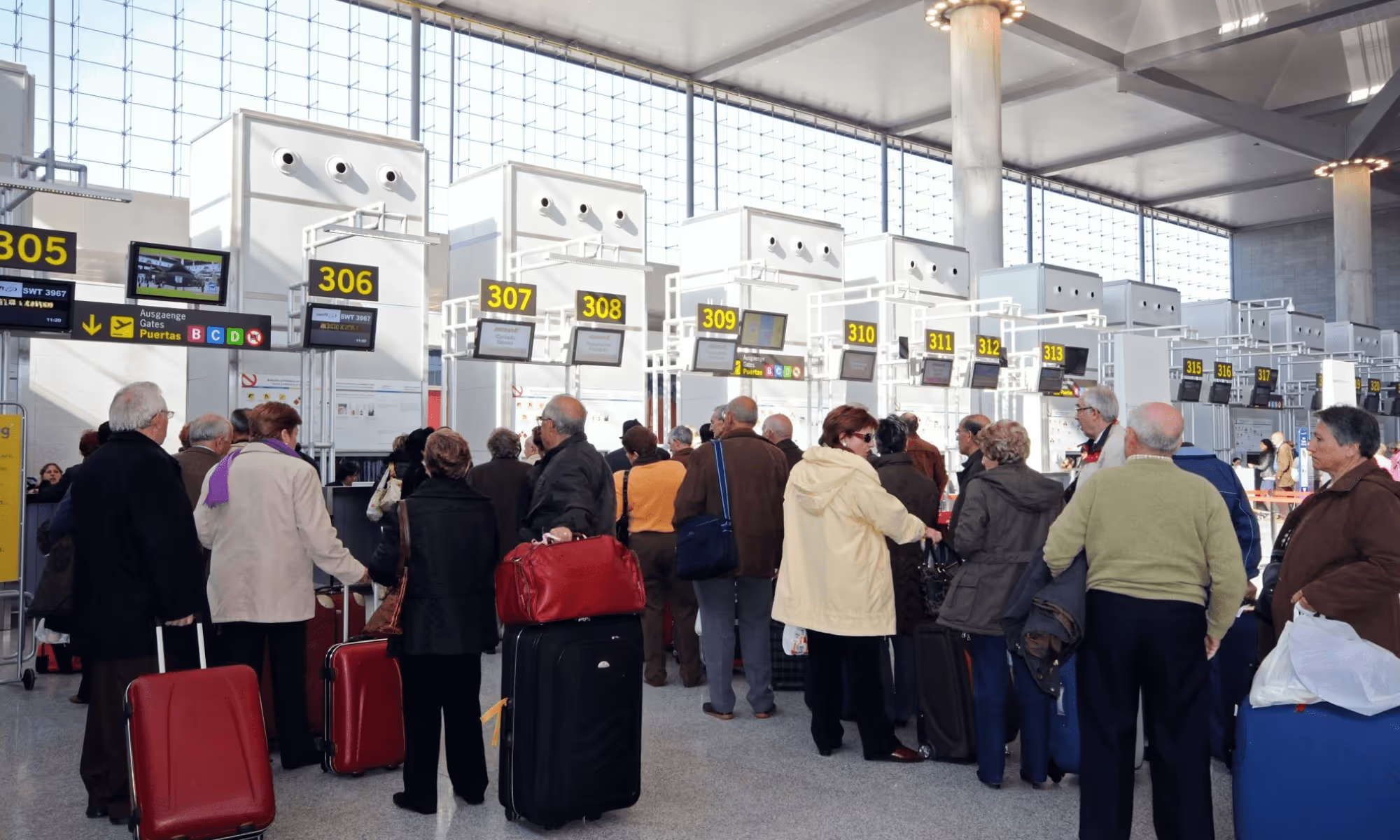
At regional airports, passengers frequently arrive in concentrated waves, e.g. a fully booked flight from London. If the processing time for a large portion of these passengers increases from around 30 seconds to several minutes per person, queues quickly backs up into the corridors. - High investment costs:
The procurement of hardware and the necessary adaptation of the IT infrastructure ties up substantial financial resources. - Personnel costs:
Although the kiosks are "self-service", experience shows that passengers require assistance during their initial registration. Airports must therefore often deploy their own ground staff to help passengers with the scanning process, aiming to relieve the federal police at the counters. - Flight Schedule Delays:
If processing times per passenger increase due to technical issues, language barriers, or system outages, it immediately causes delays in the flight schedule. If checkpoint times become too long, airlines risk missing their slots at destination airports. - The risk of domino effects:
Congestion at passport control leads to boarding delays and increases non-aviation revenue losses, as passengers no longer have time for duty-free shopping.
Why traditional queue management does not longer apply
Before EES went live, airport control rooms could accurately forecast passenger volumes using historical flight schedules and fixed, predictable processing times. Today, EES is shattering those legacy mathematical models. Terminal dynamics are now unpredictable because processing times vary from passenger to passenger: an EU citizen clears immigration in a few seconds, whereas a first-time registered EES passenger can take up to five minutes. Compounded by delayed feeder flights and unforeseen passenger structures on specific routes, these massive time variances create a rapid, domino effect that can quickly overwhelm a terminal's limited physical space.
.avif)
New ways of terminal capacity management
To prevent terminal congestion under the new EES, airports must abandon reactive queue management and transition to real-time predictive analytics. When physical space cannot be expanded and processing times per passenger increase, the efficient use of available space and time becomes a key competitive factor. Successful capacity management now relies on two essential pillars:
Dynamic passenger routing
The classic "First in - first out" principle leads to a system collapse at border controls under EES, as processing times vary drastically. For airports, this means they must intelligently segment passenger flows well ahead of the actual counters.
- Segmentation:
Separating flows into EU/EEA, EES Registered, and EES First-Time isolates the "slow" first-time registrants so they do not block the flow of faster passenger groups. - Queue Design:
Serpentine queues optimize the use of limited space and prevent stalled counters from blocking the entire line. Walking forward slowly and continuously also reduces psychological frustration for passengers. - On-Site Education:
To shorten the time spent at the EES kiosk, passengers must be prepared for the process, e.g., removing glasses or hats, while still in line, using multilingual staff, digital displays, or QR codes.
Data driven management in real time
What is required is a digital twin of the current terminal status. To make the efficiency of EES zones measurable and manageable, control rooms must expand their dashboards to include specific key performance indicators for queues.
- Queue Length:
Defines the risk of "overspill" into other terminal areas, such as the blocking of escape routes. - Waiting Time:
This is a critical factor for the passenger experience and compliance with Service Level Agreements. - Throughput:
This reflects efficiency and exposes technical malfunctions or slow processing workflows.
.avif)
How Video Analytics solves EES queue bottlenecks
The key to overcoming the EES bottleneck lies in real-time data. While various technologies can source this data, AI-based video analytics stands out as one of the most effective and cost-efficient solutions. By leveraging advanced software like Isarsoft Perception, airports can transform their existing security camera infrastructure into a precise, automated management tool for terminal operations
Video Analytics provides:
- Measurement of wait and throughput times:
The software automatically tracks when a passenger enters and exits the EES zone with up to 90% accuracy, calculating the overall throughput time. If the average processing time increases, an alarm is triggered. - Measurement of occupancy and crowd density:
Isarsoft monitors tightly confined EES zones using virtual zones within the camera view. If the critical number of people per square meter is exceeded, the system reports the overcrowding to security staff. - Predictive early warning systems and alarms:
Beyond live monitoring, Isarsoft Perception utilizes the captured data for forecasting. If the EES queue is projected to reach its capacity limit within 15 minutes, the software generates an alarm.
Real-world example: Salzburg Airport
Salzburg Airport recorded the EES waiting times of passengers during the past winter high season. Alexander Münch, Head of IT, says:
"The data is used to analyze and optimize the processes in the arrival area. By utilizing the existing camera infrastructure, the system could be implemented with minimal effort."
Read the full case study about Salzburg Airport.
What are the advantages of EES queue management with Video Analytics?
- Using the existing camera infrastructure means the investment is very cost-effective.
- Isarsoft Perception is 100% GDPR compliant. It never stores personal data and is always anonymous.
- Real-time data shows the current situation in the terminal.
- Automated and permanent monitoring and measuring 24/7.
The existing infrastructure as a strategic asset
As the EES era fundamentally rewrites the rules of border control, relying on visual checks and reactive management is no longer a sustainable operational strategy. Physical terminal expansion is heavily restricted by space and budget, meaning the future of efficient passenger throughput belongs to software, not hardware. Learn more on how to activate your existing security camera network for a predictive digital nervous system for your terminal.
FAQ
Can't find the answer to your question?
Contact us now!
What is the EES and why does it affect airport queues?
The Entry/Exit System (EES) is a mandatory EU border-control system that replaces passport stamps with biometric data capture for third-country nationals. Because processing times vary drastically between EU citizens and first-time EES registrants, queues can back up quickly compared to pre-EES processing.
Why doesn't traditional queue management work well under EES?
Traditional models assumed roughly uniform processing times per passenger, which no longer holds under EES since a first-time registrant can take several minutes versus a few seconds for an EU citizen, making static forecasts unreliable.
How does video analytics help airports manage EES queues?
Video analytics tracks how long passengers spend in the EES zone, measures crowd density against safe capacity thresholds, and can forecast when a queue is likely to hit its limit, triggering alerts before congestion becomes critical.
Does EES queue monitoring with video analytics require new cameras?
No. It uses the airport's existing camera infrastructure, which keeps implementation effort and cost low compared to installing dedicated queue-monitoring hardware.
Is EES queue monitoring with video analytics GDPR compliant?
Yes. The monitoring is based on anonymous detection and never stores personal data, keeping it fully GDPR compliant while still providing real-time queue length, wait time, and throughput data.
Explore More Publications

6 Reasons for Isarsoft Video Analytics
Isarsoft Perception turns existing security cameras into smart sensors that count people, track customer journeys and detect vehicles, with privacy built in. Here are six reasons why transit operators, airports, retailers and museums choose Isarsoft video analytics.
.png)
Artwork Protection at Kunstmuseum Stuttgart with Isarsoft
To protect priceless artworks without resorting to ropes, glass cases, or rigid sensor grids, Kunstmuseum Stuttgart implemented Isarsoft Perception's AI-powered video analytics software. By converting its existing security camera infrastructure into invisible, precision-tuned protection zones, the museum is able to automate artwork protection in real time.

Monitoring Occupancy and Seat Availability in Public Transportation
Passenger counts tell operators how many people are on board, not where the remaining capacity is or what kind it is. We look at how seat-level and multifunctional-area occupancy monitoring gives transport operators that missing data.
Why Airport Queues Are Costing More Than You Think
Learn how to optimize airport queue management with real-time monitoring, predictive flow analytics, and dynamic staff deployment. Reduce wait times, improve passenger experience, and boost operational efficiency.
.png)
EES process monitoring at Salzburg Airport with Isarsoft
To overcome the EU Entry/Exit System (EES) regulations and handle seasonal passenger surges, Salzburg Airport implemented Isarsoft Perception’s AI video analytics software. By utilizing privacy-compliant Re-Identification technology across existing cameras, the airport automated queue tracking, reduced wait times, and optimized passenger flows for both EU and non-EU travelers.
.avif)
Top 10 Airport Performance KPIs and how Video Analytics automates them
In this article we take a look at the top 10 KPIs video analytics can measure for airports. Because Isarsoft Perception supports use cases for both landside and airside operations, operations teams gain the continuous, data-driven insights needed for smarter planning without requiring costly hardware investments.