
Monitoring Occupancy and Seat Availability in Public Transportation
Passenger counts tell operators how many people are on board, not where the remaining capacity is or what kind it is. We look at how seat-level and multifunctional-area occupancy monitoring gives transport operators that missing data.
Published
September 15, 2026
.png)
Passenger counts alone tell operators how many people are on board, but not where the remaining capacity is or what kind it is. This is a gap that matters both operationally (vehicle weight, acceleration, and delay risk) and for passengers trying to find a free seat or fit a bike into a multifunctional area. This article covers what vehicle occupancy monitoring and seat availability monitoring actually are, why multifunctional areas shared by bicycles, strollers, and wheelchairs pose a distinct detection challenge, and how existing onboard cameras - already used in projects like Südostbayernbahn's "Ideenzug" - can deliver this data without new hardware. We also look at what this unlocks for operators and passengers and how it's done without compromising passenger privacy.
Why is occupancy monitoring necessary?
Vehicle occupancy has more implications for transport operators than passenger comfort alone. It also affects vehicle weight and, with it, acceleration and speed. A heavier, fuller train brakes and accelerates differently, and the probability of delays rises as loads move further from the vehicle's planned capacity.
For passengers, though, the problem is more visible: knowing that a train is "80% full" doesn't tell you which car has a free seat, whether the bike still fits in the multifunctional area, or whether a wheelchair user can board this door with enough space to turn.
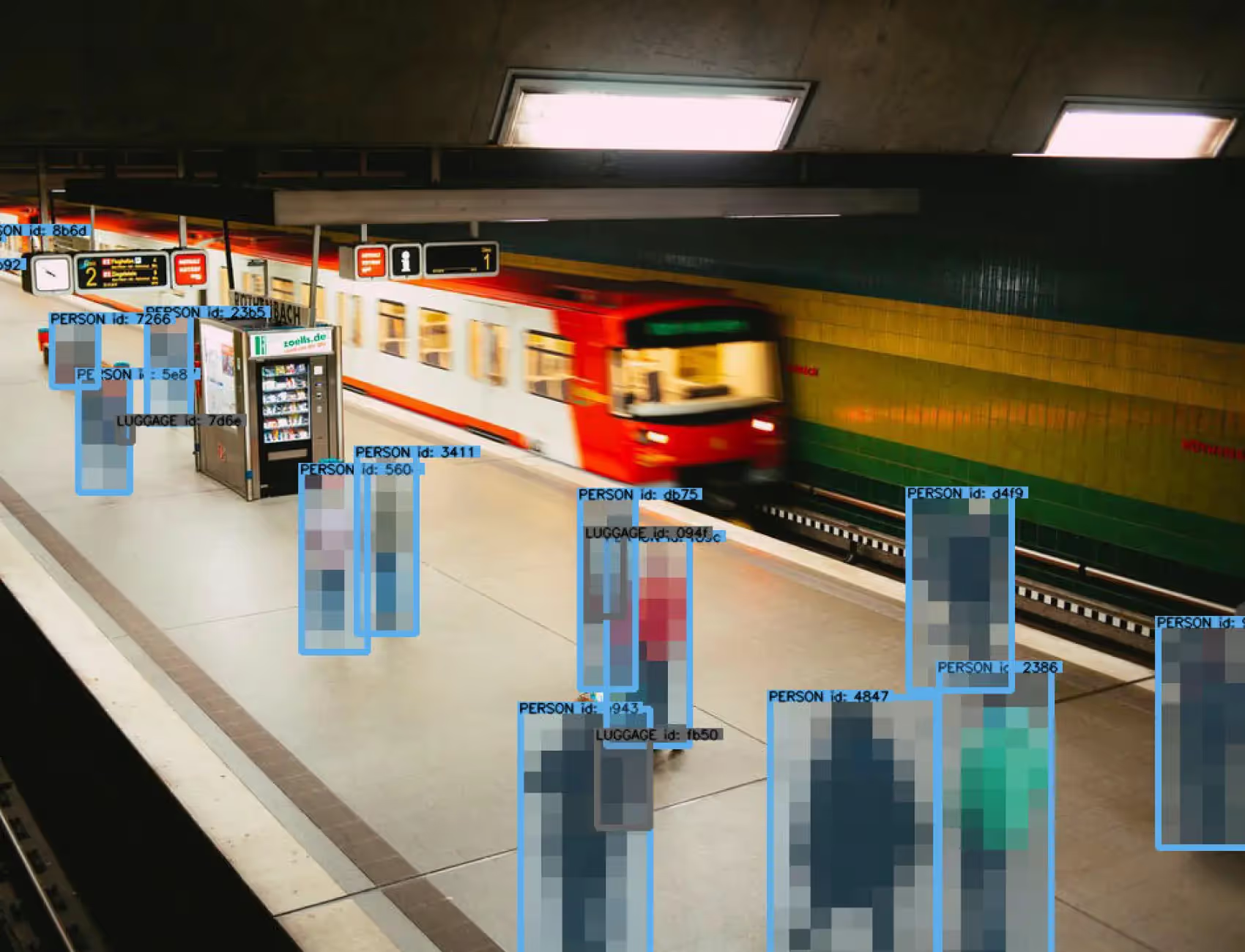
If you'd like to learn how transport operators tackle overcrowding at stations and platforms, we cover that in this article.

The paradox of occupancy in public transport
A vehicle can show 60% occupancy by passenger number while still having no free seats in the first two cars and a nearly empty third. Passenger count metrics answer the question of how many people are in a vehicle but leave a gap on where the remaining capacity is, or what kind of capacity it is. With occupancy monitoring, transport operators can close this gap.
What is vehicle occupancy monitoring?
Vehicle occupancy monitoring is the use of sensors or cameras to determine in real time how full a bus, metro, or train is and where the remaining capacity is located. Traditional automatic passenger counting (APC) systems, mounted above doors, do this at the coarsest level: a headcount of people boarding and alighting.
What is seat availability monitoring?
Seat availability monitoring goes a layer deeper, using video analytics to determine which individual seats are occupied and which are free. This data can be used to route a passenger to a specific car or display live seat maps.
In the "Ideenzug" of the Südostbayernbahn, Isarsoft demonstrated real-time occupancy in individual train carriages. The DB Colibri team says:
Existing cameras are utilized intelligently for this purpose: data processing occurs directly on the Colibri Edge Device, and transmission is carried out in compliance with data protection regulations (privacy-compliant) without the use of a cloud.The result: Real-time insights into seat availability, carriage occupancy, and even multi-purpose areas (e.g., for bicycles or strollers).
.avif)
The occupancy challenge of multifunctional areas
Multifunctional areas are the most flexible zones in trains, trams, and buses shared by bicycles, strollers, and wheelchair users. Here it is not enough to know how many people or objects are in the zone; the system has to distinguish what is occupying it because a bike, a stroller, and a wheelchair each have different space and accessibility implications.
This is also where the stakes are highest. A wheelchair user arriving at a multifunctional area that's already full of bikes has no fallback seating option the way an able-bodied standing passenger might. Object-level detection - not just people-level detection - is what makes it possible to give that passenger (or station staff) an honest answer about accessible space before boarding.
Benefits of occupancy monitoring with video analytics
The practical barrier to occupancy monitoring has traditionally been cost: dedicated seat sensors or object-specific hardware per vehicle, retrofitted across an entire fleet. AI video analytics changes that equation by using the vehicle's existing security cameras as the sensor.
Because the underlying camera infrastructure is often already in place for security purposes, adding this layer of analytics is closer to a software deployment than a hardware retrofit.
For the operator
- Real-time data for passenger information systems:
Seat and zone occupancy can feed the same displays and apps already used for arrival times, letting passengers choose a car or a service based on actual, current availability rather than an average. - Demand-driven capacity planning:
Instead of scheduling additional vehicles based on estimated peak-hour averages, planners can see actual seat and multifunctional-area utilization by route, time of day, and even day of week. - Better accessibility response:
Knowing in real time that a multifunctional area is full lets staff redirect a wheelchair user to the next vehicle or car before they reach a blocked space, rather than after. - Evidence for fleet and procurement decisions:
Utilization data on multifunctional areas specifically helps operators decide how many such zones a given route or vehicle type actually needs, rather than applying a fixed ratio across the whole fleet.
For the passenger
For passengers, the value of live occupancy means less guesswork. A passenger information display that shows a free seat two cars down, or confirms the bike area still has room replaces walking the length of a platform or vehicle to find out. For passengers who rely on a wheelchair's occupancy is more than a comfort feature; it's the difference between being able to board confidently or not. In both cases, passengers benefit from a more positive experience with the transport operator, and overall satisfaction improves.
Occupancy insights, but no compromise on privacy
Delivering this level of detail down to individual seats and object types in multifunctional areas naturally raises the question of privacy. Isarsoft Perception is built to answer it by design: all detection happens on anonymized, aggregated data, with no personal identification involved. Combined with GDPR compliance and ISO 27001 certification, operators can offer passengers this level of transparency without trading off their privacy for it. Explore how Isarsoft Perception applies this to public transport fleets.
FAQ
Can't find the answer to your question?
Contact us now!
How do transport operators detect free seats in real time?
By applying AI video analytics to the vehicle's existing onboard cameras, which are trained to distinguish occupied from empty seats within each car. The resulting data is aggregated and can be pushed to passenger information displays, apps, or operations dashboards without requiring new hardware.
Can existing bus or train cameras be used for occupancy detection?
Yes. Because the analysis happens in software applied to the video feed, most existing onboard security cameras can be used as the data source, avoiding a fleet-wide retrofit with dedicated occupancy sensors.
What is a multifunctional area in a train, and how is it monitored?
A multifunctional area is a flexible onboard zone shared by bicycles, strollers, and wheelchair users. It's monitored by video analytics that not only counts occupancy but classifies the type of object present, since a bike, a stroller, and a wheelchair each affect available space and accessibility differently.
Is occupancy monitoring different from automatic passenger counting (APC)?
Yes. Standard APC counts people boarding and alighting at doors, giving an overall headcount per vehicle. Seat-level and zone-level occupancy monitoring goes further, identifying availability within specific seats or areas of the vehicle.
Is occupancy monitoring the same as overcrowding prevention?
Related, but not the same. Overcrowding prevention is about keeping density in a space - a platform or vehicle within safe limits. Seat and multifunctional-area occupancy is about giving passengers and operators granular visibility into where capacity exists once they're already in or boarding a vehicle.
Explore More Publications
.png)
On-Camera People Counting & Video Analytics with Isarsoft Perception Axis App
Isarsoft Perception now runs directly on the latest Axis cameras, eliminating the need for additional edge servers. Discover how on-camera analytics is transforming onboard vehicle deployment and opening the door to use cases previously limited by budget or space constraints.

Tackling Overcrowding with Video Analytics for Public Transport
This article explains how overcrowding occurs, highlights the negative consequences of it in public transportation, points out the options either for prevention or measures against overcrowding, and addresses how Isarsoft Perception can be a smart solution.
Automatic Passenger Counting (APC) Systems - An Overview
Discover different technologies for Automatic Passenger Counting (APC) their strengths and weaknesses, and the advantages of the AI-powered solution by Isarsoft.
Tackling Overcrowding with Video Analytics for Public Transport
This article explains how overcrowding occurs, highlights the negative consequences of it in public transportation, points out the options either for prevention or measures against overcrowding, and addresses how Isarsoft Perception can be a smart solution.

Automatic Passenger Counting (APC) in Trains and Buses with Cameras
Buses, trains, subways, and trams already have security cameras installed. Why not put them to more efficient use? Discover how AI-powered video analytics turns your existing camera infrastructure into a precise, automated passenger counting system — reducing hardware costs while giving you real-time data on occupancy, passenger flows, and utilization.

How to visualize Passenger Flow in Public Transport Networks
Understanding how passengers move through stations, vehicles, and the wider network is essential for transit operators. Explore how video analytics turns raw movement data into clear, actionable passenger flow visualizations.